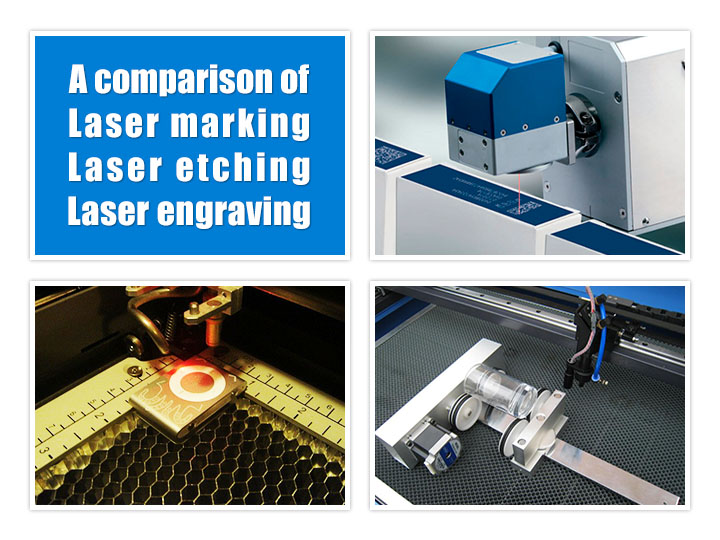
Compare technical parameters, built-in functions, applicable scenarios, strengths and weaknesses of laser engraving devices, laser marking equipment and laser laser etching systems to help you select the most suitable laser processing machine for your production demands.
A Full Comparison: Laser Engraving Machine, Laser Etching Machine and Laser Marking Machine
Laser engravers, laser etching equipment and laser marking machines all adopt laser thermal processing technology to realize surface processing on diverse raw materials. Although they share identical laser working fundamentals, each equipment category carries exclusive functional features and targeted design to match different production tasks.
All three laser devices can leave non-fading permanent identifiers on semi-finished workpieces and finished products. Operators can carve text, serial codes, component model numbers, corporate trademarks, barcodes, QR codes, 2D data matrix codes onto flat metal sheets, curved workpieces and cylindrical parts. The applicable metal surfaces include raw bare metal, painted layers, anodized coatings and electroplated plating layers.
With the continuous upgrading of CNC laser control technology, laser engraving, laser etching and laser marking processing techniques have gained wider popularity across all manufacturing sectors. The three laser processing methods all deliver permanent anti-wear marking effects, satisfy industrial production standard specifications and endow products with unique identification features.
How to Distinguish Laser Engraving, Laser Etching and Laser Marking Equipment?
Market practitioners often mix up these three professional terms, yet obvious functional and processing distinctions exist between the three laser machines. Every laser device owns unique processing characteristics and applicable ranges, making each one more fit for specific processing assignments.
Laser Engraving Machine
Laser engraving equipment is mainly applied to carve custom patterns, decorative textures and character text on a huge range of substrates, covering timber, various metals, glass, acrylic boards and plastic raw materials. Such machines emit high-energy concentrated laser beams to strip away part of the material surface layer, forming concave carved traces. Users can adjust processing times to realize shallow light engraving or deep heavy engraving based on personalized aesthetic requirements.
Laser engravers are widely used for personalized customization, handmade art creation and customized merchandise production. They can be seen in independent processing workshops, industrial production factories and retail customization stores to fabricate metal signs, commemorative trophies, custom jewelry and personalized gift crafts.
Laser Engraving Working Mechanism
Laser engraving refers to a physical material removal process: high-energy laser beams vaporize surface substances of raw materials to form visible concave grooves that can be directly felt by hands.
- The concave carved pits generated are visible to naked eyes and have obvious tactile sense.
- Single laser pulse can instantly vaporize materials, so the whole processing flow is highly efficient.
- Multiple repeated laser scans are required if users need deeper carving depth.
- Mass heat energy will be released during engraving, leading to instant gasification of contacted material layers.
Laser engraving belongs to a branch of laser marking technology, but it still holds clear differences compared with etching and marking:
- It is the top choice for merchants providing personalized custom processing services.
- Three mainstream laser engraving types are available: surface etching, deep depth engraving and laser ablation; their core gaps lie in processing substrate types and material removal volume.
- Not suitable for marking key components with strict safety standards.
- It boasts the fastest processing efficiency among all laser marking solutions.
- The maximum engraving depth on metal materials reaches 0.020 inches, while graphite materials can support a carving depth up to 0.125 inches.
- Perfect for workpieces that need to withstand long-term friction and heavy abrasion.
- Compatible with nearly all metals, plastics, wood, leather and glass for carving operations.
- Main processing objects include serial numbers, brand logos and decorative patterns.
We also list the gaps between laser engraving and traditional mechanical carving:
- Laser engraving supports richer font libraries and customizable fonts.
- It adapts to more types of processing substrates.
- Tiny workpieces such as jewelry get clearer, more legible marks via laser engraving.
- Laser engraving machines run much faster than conventional carving equipment.
- The risk of workpiece surface scratch, deformation or damage is greatly lowered.
Laser Etching Machine
Laser etching devices share similar structures with engraving machines, yet they focus on ultra-shallow surface marking. High-energy laser beams melt or partially gasify the thin top layer of raw materials, generating permanent identification traces without forming deep concave structures.
Laser etching technology is extensively adopted for product identity labeling, serial number coding and brand trademark printing. Mass industries including electronics manufacturing, automobile production, medical apparatus processing and aerospace component factories utilize etching machines to mark product logos, serial codes, barcodes and other identification data on parts.
Laser Etching Working Mechanism
As a derivative processing method under laser engraving, laser etching relies on laser thermal energy to melt the material’s outermost surface layer.
- Different from deep engraving, the material removal depth of etching stays below 0.001 inches.
- High-temperature laser beams instantly melt the surface substrate.
- Melted substances expand rapidly and form slight raised marking lines on the surface.
Core differences between laser etching, engraving and marking:
- Only less than 0.001 inch of surface material will be removed during processing.
- Applicable processing materials include bare metal, anodized metal, electroplated metal, polymer plastic and ceramic blanks.
- Laser etching changes the metal surface’s original smooth finish, adjusts light reflectivity and improves mark contrast visibly.
Laser Marking Machine
Laser marking equipment is a multi-functional laser processing device for manufacturing ultra-precise, wear-resistant permanent marks on all kinds of substrates.
Distinct from engraving and etching processes, laser marking will not strip any material layer off workpieces. Instead, laser thermal energy triggers chemical reactions or surface color variation to form identification patterns.
This type of machine creates high-contrast ultra-fine marks with outstanding precision and rapid processing speed, making it ideal for delicate decorative patterns, serial number coding, brand trademarks and tiny 2D data matrix codes.
Laser marking machines are widely equipped in electronics factories, medical device workshops, aerospace enterprises, auto assembly plants and consumer goods production lines, supporting product traceability, brand printing, batch serial coding and component identity marking.
Laser Marking Working Mechanism
Laser marking works through thermal interaction between laser beams and material surfaces, which slightly modifies the surface physical and chemical properties to form visible marks.
The laser beam heats the substrate moderately to induce surface oxidation reaction, turning local areas black without damaging the workpiece body.
Operators adopt low-power laser beams moving slowly on the material surface to realize surface discoloration, generating high-contrast patterns without any surface damage.
The complete processing maintains the original intact surface structure of raw materials.
Low-temperature thermal treatment is applied on metal surfaces to finish annealing marking.
Key distinctions separating laser markers from engravers and etchers:
- Perfect equipment for printing barcodes, UID coding, QR codes, trademarks and various identity labels.
- Four mainstream laser marking techniques are commonly used in industry: metal annealing marking, carbon migration marking, plastic foaming marking and surface color alteration marking.
- Widely used in medical industry for stainless steel and titanium alloy component marking; it also supports processing other substrate materials.
- It has multiple aliases: laser color marking, laser black marking; plastic processing is called charring marking, while metal processing is named annealing marking.
- Such processing services are not universally available across all laser processing factories.
In conclusion, laser engraving machines, laser etching machines and laser marking machines are essential industrial and commercial processing equipment, capable of producing permanent patterns, text and identity codes on diversified raw materials. Every laser device holds exclusive processing performance to match unique production requirements, supplying manufacturers and trading companies with flexible laser marking and customized carving solutions.