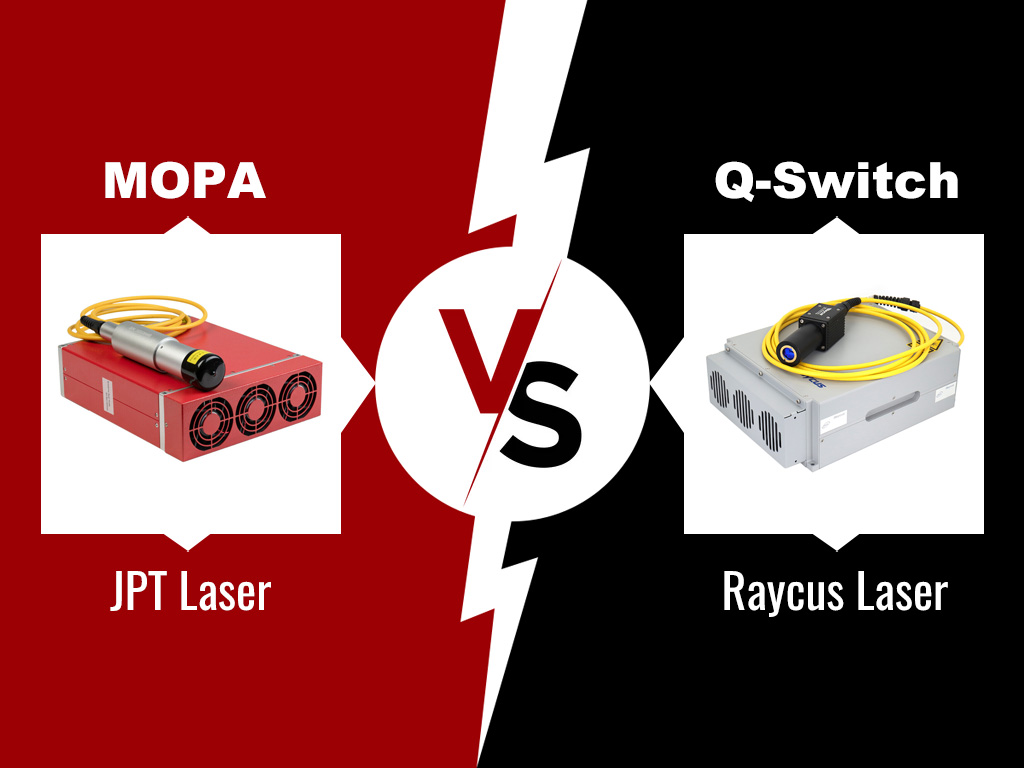
What similarities and functional gaps exist between MOPA fiber laser marking devices and Q-switched fiber laser marking machines? This article conducts a full performance review of these two mainstream pulsed fiber laser marking solutions.
MOPA Fiber Laser Marker VS Q-Switched Fiber Laser Marker
Basic Definition of MOPA & Q-Switched Pulsed Fiber Lasers
MOPA stands for Master Oscillator Power Amplifier, referring to a cascaded laser structure composed of an oscillation seed light source and power amplifier. In industrial processing sectors, MOPA nanosecond pulsed fiber lasers adopt semiconductor seed chips matched with fiber amplifiers driven by electrical pulse signals, featuring powerful adjustable performance and intelligent parameter control.
The core intelligent advantage of MOPA lasers lies in independently tunable pulse width ranging from 2 nanoseconds to 500 nanoseconds, and its repetition frequency can reach megahertz ultra-high frequency output.
By contrast, Q-switched fiber lasers install optical loss modulators inside fiber resonant cavities. Periodic adjustment of intracavity optical loss generates fixed nanosecond pulse light signals for marking workpieces.
Nanosecond pulsed fiber lasers are widely adopted for industrial metal marking, surface cleaning, micro welding and thin material cutting. As two mainstream technical architectures of nanosecond pulse lasers, MOPA and Q-switched lasers differ greatly in internal structure, optical output indicators and applicable processing scenarios. We will make an in-depth comparative analysis below.
Internal Structure Comparison
The core structural distinction between MOPA fiber laser generators and Q-switched fiber laser sources lies in the generation method of initial pulse seed light.
- MOPA fiber laser: Pulse seed signals are produced when electrical pulses drive semiconductor laser chips. The output optical properties are directly controlled by electrical drive signals, supporting flexible independent adjustment of multiple pulse indicators including pulse width, repetition frequency, pulse waveform and peak power.
- Q-switched fiber laser: Pulsed light is generated through periodic fluctuation of optical loss inside resonant cavities. Its internal layout is simpler with lower manufacturing costs, yet the built-in Q-switch component restricts adjustable ranges of all pulse parameters.
Optical Performance Parameter Comparison
- Pulse Width AdjustabilityMOPA fiber lasers support arbitrary continuous pulse width tuning within 2ns–500ns. Narrower pulse width creates smaller heat-affected zones and delivers ultra-precise micro-processing effects.Q-switched fiber lasers feature fixed non-adjustable pulse width, locked steadily between 80ns and 140ns during operation.
- Repetition Frequency RangeMOPA fiber lasers realize MHz-level high repetition frequency output. High frequency brings faster marking efficiency, while MOPA equipment can sustain stable high peak power even under maximum frequency operation.Constrained by Q-switch component operating limits, Q-switched fiber lasers only reach around 100kHz maximum repetition frequency with narrow adjustable frequency bands.
Practical Application Comparison
1. Stripping Anodized Layer on Thin Aluminum Sheets
Countless smartphones, tablets and laptops adopt ultra-thin anodized aluminum shells. Traditional Q-switched laser marking easily causes material deformation and bulging bumps on the back of thin aluminum panels, ruining product appearance.
MOPA lasers can adopt ultra-narrow pulse width parameters, shortening laser material contact time. Sufficient instantaneous energy completely removes the anodic oxide film without deforming thin aluminum substrates, forming delicate uniform white frosted surfaces. Thus MOPA lasers are the optimal choice for thin aluminum oxide layer stripping processing.
2. Black Color Marking on Anodized Aluminum Surfaces
Marking dark black logos, model numbers and text on anodized aluminum shells has become mainstream technology widely used by Apple, Huawei, Lenovo, Samsung and other electronics brands in recent years.
This black marking effect can only be realized by MOPA fiber lasers. Relying on wide adjustable ranges of pulse width and frequency, narrow pulse & high frequency parameter combinations produce pure black matte marks; diverse parameter matching schemes can generate different grayscale marking layers as customized demands. Q-switched lasers cannot achieve this black marking effect.
3. Precision Machining for Electronics, Semiconductors and ITO Films
Electronics and semiconductor precision manufacturing requires ultra-fine thin marking lines. Fixed pulse width limits of Q-switched lasers make it impossible to process ultra-fine smooth edge lines.
MOPA lasers flexibly tune pulse width and frequency, creating ultra-thin marking tracks with smooth, burr-free edges for ITO film, chip and micro component processing.
Application Performance Comparison Table
表格
| Processing Workpiece | Q-Switched Laser Marking Machine | MOPA Laser Marking Machine |
|---|---|---|
| Thin aluminum anodic layer stripping | Prone to deformation, coarse marking texture | Zero deformation, delicate uniform marking |
| Black marking on anodized aluminum | Not supported | Adjustable parameters produce multiple black grayscale effects |
| Deep engraving on metal surfaces | Coarse uneven carving texture | Smooth delicate deep marking layers |
| Color marking on stainless steel | Hard parameter debugging, easy out-of-focus discoloration | Adjustable parameters generate diverse colorful marking effects |
| PC, ABS plastic marking | Yellow burnt edges, rough surface texture | Smooth marking without yellow edge oxidation |
| Light-transmitting paint keyboard processing | Not available | Effortless light-transparent effect molding |
| Precision processing for semiconductors, electronic parts and ITO films | Fixed wide pulse width, unbalanced output power | Adjustable pulse parameters form optimal light spots with balanced energy distribution |
From the above application contrast, Spiritore MOPA fiber laser marking machines can substitute Q-switched laser marking equipment for most processing tasks, and show obvious performance advantages in high-end precision industrial manufacturing scenarios.
Technical Parameter Comparison (Model STJ-30F Q-switched VS STJ-30FM MOPA)
| Parameter Item | STJ-30F (Raycus Q-Switched Fiber Laser) | STJ-30FM (JPT MOPA Fiber Laser) |
|---|---|---|
| Rated Laser Power | 30W | 30W |
| Pulse Width Range | 90–120ns | 6–250ns |
| Power Adjustment Range | 10%–100% | 0%–100% |
| Single Pulse Energy | 1mJ | 0.5mJ |
| Beam Quality M² | <1.5 | <1.3 |
| High-Reflection Material Resist Performance | No | Yes |
| Laser Beam Diameter | 7±1mm | 7±0.5mm |
| Laser Wavelength | 1064nm | 1064nm |
| Modulation Method | Coupling Amplification | Coupling Amplification |
| Optional Marking Area | 100×100mm / 200×200mm / 300×300mm | Same as left |
| Maximum Marking Speed | 7000mm/s | 7000mm/s |
| Marking Depth Range | 0.01~0.5mm (depends on raw materials) | Same as left |
| Minimum Line Width | 0.01mm | 0.01mm |
| Minimum Character Size | 0.2mm | 0.2mm |
| Cooling Form | Air Cooling | Air Cooling |
| Input Power Supply | 220V/50Hz | 220V/50Hz |
| Positioning Indicator | Red Dot Pointer | Red Dot Pointer |
| Supported Marking Content | Text, Graphics, Images | Text, Graphics, Images |
| Operating System Compatibility | Win7 / Win8 / Win10 | Win7 / Win8 / Win10 |
| Control Software | EZCAD | EZCAD |
| Importable Graphic Formats | bmp, jpg, gif, tga, png, tif, ai, dxf, dst, plt | Same as left |
| Total Machine Power Consumption | ≤700W | ≤700W |
Summary
To sum up, MOPA fiber lasers feature broader adjustable parameter ranges, flexible optical performance tuning and wider applicable processing fields compared with Q-switched fiber lasers. Under identical laser power configuration, Q-switched fiber laser marking machines hold prominent price and cost advantages.
These two laser technologies form a mutually complementary relationship in the industrial nanosecond pulse laser processing market, matching different customer production budgets and precision processing demands respectively.