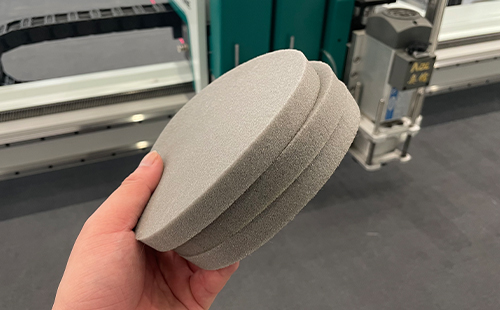
Memory foam, also called slow rebound foam or space foam, is mainly made of polyurethane foam. It differs greatly from ordinary high resilience foam with three core features:
1. Viscoelasticity and slow rebound. It recovers slowly after compression. The material is easy to be pushed and deformed by the cutting blade, resulting in skewed cuts and dimensional errors. Stable material holding becomes the top priority.
2. Temperature sensitivity. Memory foam gets softer when temperature rises. All thermal cutting methods tend to leave yellow, crusty cut surfaces with irritating odors, damaging the appearance and rebound performance of finished products.
3. Wide density range. Memory foam varies from low density to high density with different softness, requiring different blade selection and machine rigidity.
When selecting memory foam cutting equipment, focus on two core points: stable material clamping to avoid deformation, and clean cut surface without burnt edges, burrs or collapse.
Five Mainstream Memory Foam Cutting Methods
1. Oscillating Knife Cutting Machine
Working principle: Physical cold cutting with high-frequency vibrating blade. The CNC Oscillating Knife Cutter produces no heat during cutting.
Advantages: Cold cutting without burnt edges, no molds for irregular shapes, smooth cut surface and fast style change.
Disadvantages: Higher investment than hot wire cutter. High-spec models are required for thick and high-density foam.
Applications: Memory pillows, lumbar cushions, seat cushions and other contoured parts, suitable for small-batch and multi-style production.
2. Hot Wire Cutting Machine
Working principle: Hot wire melts foam body by heating.
Advantages: Low machine cost, suitable for simple symmetrical shapes such as square pillows and cylindrical pillows.
Disadvantages: Yellow crusty cut surface with odor, low precision and low efficiency.
Applications: Simple shapes, limited budget and low requirements on cut surface quality.
3. CNC Horizontal / Band Knife Cutting Machine
Working principle: High-speed rotating endless band knife.
Advantages: Fast slicing and block cutting with low unit cost.
Disadvantages: Poor ability for irregular contours. Precision fluctuates for large-format horizontal slicing.
Applications: Slicing and blocking large foam blocks for mattress cores and cushion inserts.
4. Die Punching
Working principle: One-time stamping forming by cutting dies.
Advantages: Extremely high efficiency and consistent dimension for mass production of standard parts.
Disadvantages: New dies required for every new product. High mold cost and long lead time for style changes.
Applications: Stable large orders of single standard products.
5. Laser Cutting Machine
Working principle: Laser ablation cutting.
Advantages: Non-contact cutting for ultra-thin materials.
Disadvantages: Thick memory foam suffers burnt yellow edges and strong odors. It is rarely used for main memory foam cutting tasks, only for individual thin foam sheets.
Industry tips: Choose oscillating knife for high cutting precision; band knife for high volume production of low density foam. Pneumatic knife head with larger amplitude works better for thick and soft foam.
Match Equipment by Product Type
✅ Memory pillows, cervical pillows, lumbar supports and contoured cushions: Prefer CNC Oscillating Knife Cutter. Import CAD drawings directly for cutting without molds. Almost zero cost for sampling and style change. It is the mainstream Flatbed Digital Cutter for memory foam contour processing.
✅ Mattress cores and large foam block slicing: Use CNC horizontal cutting machine to slice foam blocks, then use oscillating knife for contour cutting. This two-step solution is widely adopted by home sponge factories.
✅ Roll materials and continuous feeding: Equip Oscillating Knife Cutting Machine with automatic feeding system or CCD vision edge tracking for continuous nesting cutting, suitable for rolled memory foam and composite fabrics.
✅ Stable large orders of single standard product: Die punching can be considered after calculating mold cost and order quantity.
✅ Simple square pillows and cylindrical pillows with limited budget: Hot wire cutting is acceptable, but yellow crusty cut edges and secondary finishing work should be expected.
If you are unsure, send drawings and foam samples to manufacturers for trial cutting. Check cut quality, accuracy and speed before confirming machine model.
7 Key Parameters for Memory Foam Oscillating Knife Cutter Selection
1. Working area: Reserve more than 10% margin based on maximum workpiece size to handle larger orders in future.
2. Cutting height: High beam model is required for high-density memory foam thicker than 8~10cm to prevent cutting collapse.
3. Knife head configuration: Standard oscillating knife for regular thickness; pneumatic knife with larger amplitude for thick soft foam; servo oscillating knife with high rotating speed for smoother cuts. Select according to your main foam thickness.
4. Vacuum adsorption table: Memory foam deforms easily. Strong vacuum adsorption directly guarantees vertical cuts and stable dimensions.
5. Automatic nesting software: Material saving rate can reach 5%~15%. It greatly improves efficiency for multi-style sampling.
6. Optional accessories: Automatic roll feeder, CCD vision edge tracking, dust collection system, selected according to actual production process.
7. Manufacturer capacity and after-sales service: Check welded machine frame, brand of servo motors, free trial cutting service and after-sales response speed. These factors matter more than simply comparing prices.
Three Common Buying Mistakes
1. Using laser cutting for memory foam. Laser can hardly cut thick memory foam. It causes burnt yellow edges, strong odors and damages rebound performance.
2. Only comparing prices and ignoring configurations. Low-cost machines usually lack vacuum adsorption and weak motors. Severe deformation occurs when cutting contour pillows, leading to material waste far exceeding machine price difference.
3. Believing molds are mandatory for contour shapes. With CNC Oscillating Knife Cutter, you can cut directly by importing CAD drawings without cutting dies for sampling and modification.
FAQ: Frequently Asked Memory Foam Cutting Questions
Q: How much does a memory foam oscillating knife cutting machine cost?
A: Price depends on working size, knife head configuration and vacuum system. The price gap between different configurations is large. Provide drawings and maximum foam thickness to manufacturers for quotation and customized solution.
Q: What is the maximum thickness of memory foam that oscillating knife can cut?
A: Standard models stably handle memory foam within 5~10cm. High beam models can process high-density memory foam over 10cm, with vacuum adsorption to prevent collapse during cutting.
Q: Why do memory foam cut edges turn yellow?
A: It is usually caused by thermal cutting methods such as hot wire and laser. Memory foam is temperature sensitive. Heat creates yellow crusty layers on cut surface. Switch to cold cutting like oscillating knife to solve this problem.
Q: Are cutting dies required for memory foam contour cutting?
A: No. CNC Oscillating Knife Cutter directly cuts after importing CAD files. Zero mold cost for sampling and revision.
Conclusion
To select memory foam cutting machine, confirm product type, output volume and frequency of style changes first. For contoured parts and frequent style updates, CNC Oscillating Knife Cutter is preferred. For slicing large foam blocks, choose CNC horizontal or band knife cutter. For mass standard products, evaluate die punching after cost calculation. Send drawings and foam samples for free trial cutting before placing orders, check cut surface, precision and speed to make final decision.