Polyester fiber cotton (PET fiber cotton) is a porous, fluffy synthetic fiber material, widely applied in acoustic panels, sound insulation cotton, automotive interior parts, filter materials and home textile filling. Many processors encounter similar troubles during cutting: traditional blade cutting compresses the material and leaves rough edges; laser cutting causes burnt yellow edges and pungent smoke; die stamping requires new dies for every new pattern, leading to high costs and long lead times.
The cutting difficulties stem from its material properties: low melting point, high resilience and porous structure. It compresses easily under pressure and melts or releases harmful gas when exposed to heat. Therefore, not all cutting machines are suitable. The core principle for equipment selection is matching the machine to the material, rather than only focusing on machine parameters.
Three Mainstream Cutting Methods: Features & Suitable Applications
There are three primary technical routes for polyester fiber cotton cutting: Oscillating Knife Cutting, Laser Cutting and Ultrasonic Cutting. Their working principles differ greatly, and each fits distinct production scenarios.
1. Oscillating Knife Cutting – Physical Cold Cutting, the Most Reliable Option
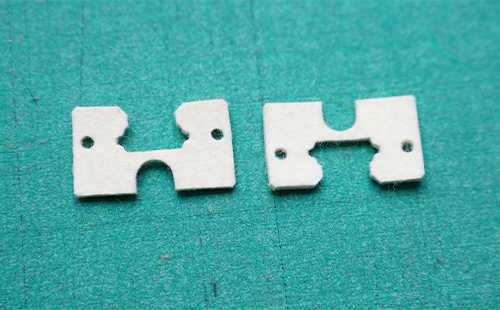
The CNC Oscillating Knife Cutter uses a motor to drive the blade to vibrate up and down tens of thousands of times per minute. The cutting head moves along preset paths, cutting the material like a fast electric saw. No heat is generated in the whole process, so there is no melting, burnt edge or odor. It perfectly preserves the structural integrity of polyester fiber cotton, delivering clean and sharp cut edges without fiber pulling or material compression.
Another advantage is flexible tool change. Operators can quickly swap round knife, half-cut knife, V-angle bevel knife, milling cutter and other tools. One Flatbed Digital Cutter can complete straight cutting, 45° chamfering, V-grooving, hollowing and punching. It is ideal for mass production of polyester fiber acoustic panels and sound insulation soft packages. The repeat positioning accuracy of mainstream oscillating knife machines reaches ±0.1mm, while high-end models can stably achieve ±0.05mm. In terms of price, basic CNC oscillating knife cutting machines start from 60,000 to 100,000 RMB. Models equipped with vision recognition systems range from 100,000 to 200,000 RMB.
2. Laser Cutting – Thermal Processing with High Speed but Side Effects
Laser Cutting Machine uses high-energy light beams to melt or vaporize materials. It features fast cutting speed, narrow kerf and ultra-high precision up to ±0.02mm. Under laser irradiation, polyester fibers melt and re-solidify to form sealed edges, effectively preventing fiber abrasion and fraying. This is the unique advantage of laser processing.
However, thermal effects bring obvious drawbacks. When cutting polyester fiber cotton, the melted edges have different acoustic properties compared to the rest of the board, which may undermine the acoustic consistency of acoustic panels. Smoke and gas generated during cutting need professional ventilation and filtration systems, increasing operation complexity and cost. Laser machine prices vary widely from tens of thousands to millions of RMB. CO₂ laser machines for flexible material cutting generally cost between 100,000 and 300,000 RMB.
3. Ultrasonic Cutting – Edge Sealing for Synthetic Fibers
Ultrasonic cutting generates friction heat at the contact surface between the cutter head and material through high-frequency vibration, instantly melting and sealing the cut edge. It can finish cutting and edge sealing in one step, perfectly solving fiber pulling and loose edges for polyester fiber cotton. It is widely used for nonwoven fabrics and chemical fiber textiles.
Nevertheless, ultrasonic equipment has strict limits on material thickness and density. It works better for thin to medium-thick polyester materials with relatively high equipment investment. Handheld models also cost tens of thousands of RMB. It is not the preferred choice for large-area and thick sheet processing.
Three Hard Indicators You Must Check When Purchasing
After confirming the cutting technology, three easily overlooked but critical factors determine long-term use performance.
1. Machine Frame Rigidity Decides Precision and Service Life
Oscillating Knife Cutting Machine works under high-frequency vibration. The cutting head bears tens of thousands of direction-changing impacts every minute. If the frame is not heavy and stable enough, problems like deformed circles, angle deviation and frame shaking will occur after one or two years. Simple inspection method: check whether the frame adopts thick-walled square steel integral welding and high-temperature stress relief annealing. These processes directly affect the machine precision after ten years of operation.
2. Tool System Determines Processing Capacity
High-quality Digital Cutting Machine supports fast replacement of multiple tools including oscillating knife, round knife, V-type bevel knife and drag knife. If you need 45° mosaic chamfering or V-grooving for polyester fiber acoustic panels, confirm the machine supports corresponding tools and processes. Machines with only one single tool have limited upgrade potential later.
3. Nesting Software Improves Material Utilization
Polyester fiber cotton boards are not cheap, and nesting optimization directly affects profit margins. Machines equipped with intelligent nesting software can raise material utilization by more than 10%. In the long run, saved material costs may exceed the price difference between different machine models.
Quick Selection Guide by Production Scenarios
Still unsure which polyester fiber cotton cutting machine to buy? Follow this logic:
✅ If you produce polyester fiber acoustic panels and sound insulation boards, requiring grooving, chamfering, hollowing and multiple processes → Choose CNC Oscillating Knife Cutter. All-in-one solution, eco-friendly without burnt edges.
✅ If you process continuous polyester fabric rolls and pursue high-speed mass cutting → Choose CO₂ Laser Cutting Machine with conveyor system, prioritize production efficiency.
✅ If you process thin polyester nonwoven fabrics with strict edge sealing requirements → Choose ultrasonic cutting machine to complete cutting and edge sealing in one pass.
✅ If you just start polyester fiber cotton processing with limited budget and diverse demands → Flatbed Digital Cutter is your priority, moderate investment and strong adaptability.
Conclusion
There is no "best" cutting machine, only the most suitable one matching your material and production capacity. Before final purchase, send your actual material samples to the manufacturer for cutting tests. Checking the real cutting effect is more reliable than reading any parameter datasheet.