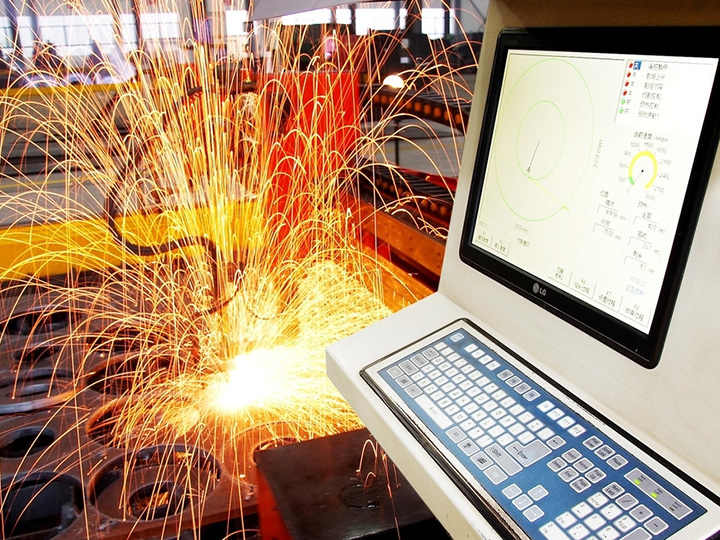
CNC plasma cutting equipment serves to process metal sheets, custom metal signage, metal decorative crafts as well as metal tubes and pipes, catering to hobby DIY enthusiasts, small-scale factories and full industrial production lines.
What is a CNC plasma cutter?
CNC plasma cutting refers to a thermal cutting technique that slices electrically conductive metals through high-speed jets of superheated plasma gas. Plasma torches can process multiple conductive metal workpieces including carbon steel, aluminum alloy, brass and copper, alongside other conductive metallic materials. Spiritore CNC plasma cutting machines are widely deployed in metal fabrication workshops, vehicle maintenance and restoration factories, industrial construction projects, metal waste recycling and scrap processing facilities. Boasting fast cutting speeds, high dimensional precision and affordable operating costs, Spiritore CNC plasma cutters cover a broad application spectrum ranging from large industrial automated production lines down to compact hobby workstations.
The core operating logic of CNC plasma cutting relies on building a closed electrical circuit: the device generates ultra-hot ionized gas (plasma), which passes through the metal workpiece, then returns to the machine’s main unit via a ground clamp to complete the circuit. Operators feed compressed gas mixtures (compressed air, oxygen, inert gas, customized according to metal types) through a narrow focused nozzle at high velocity toward the cutting material. An electric arc forms between an electrode embedded inside the nozzle and the workpiece, ionizing the passing gas stream to form a conductive plasma channel. Electric current flows through this plasma channel and releases massive thermal energy to melt the target metal. Meanwhile, high-speed plasma flow and compressed gas blow away molten metal residue, achieving complete separation and cutting of raw metal materials.
Since Spiritore CNC plasma cutting torches produce a concentrated, localized high-temperature plasma cone, this equipment excels at cutting metal plates into curved, irregular and angled custom profiles.
Traditional analog CNC plasma cutting units (normally over 2kW power output) adopt bulky industrial frequency transformers. Inverter-type plasma cutters first convert alternating mains power into direct current, then feed DC power to high-frequency transistor inverters operating between 10kHz and 200kHz. Higher switching frequency standards allow manufacturers to adopt smaller transformers, greatly reducing the overall volume and weight of the cutting device.
Early inverter equipment applied MOSFET transistors, while modern models gradually adopt IGBT modules as mainstream power components. Parallel-connected MOSFET chips carry hidden risks: premature triggering of a single transistor may trigger chain damage that destroys one quarter of the entire inverter module. IGBT technology effectively avoids such cascading failure risks, making IGBT components the standard choice for high-current heavy-duty cutting equipment where parallel MOSFET layouts fail to meet power demand.
The mainstream switching circuit framework for inverter plasma cutters is dual-transistor offline forward converter topology. Though lightweight and high-output, older inverter plasma devices without power factor correction cannot run stably with generator power supplies; official manufacturer guidelines prohibit such usage except for tiny portable low-power generators. New-generation Spiritore plasma cutters integrate optimized internal circuit modules, enabling stable operation with compact portable generators even without power factor correction hardware.
Many equipment suppliers independently manufacture dedicated CNC cutting worktables, while some brands integrate plasma cutting power supplies directly into the cutting table framework. CNC worktables utilize computer programs to precisely control torch movement, delivering smooth, burr-free cutting edges. Advanced multi-axis Spiritore CNC plasma cutting equipment can process thick metal plates and create complex beveled welding grooves unachievable with conventional cutting tools. For ultra-thin metal sheets, laser cutting has gradually replaced plasma cutting in many scenarios, mainly due to laser cutters’ superior performance in precision hole machining.
HVAC duct manufacturing is a unique specialized application field for Spiritore CNC plasma cutters. Dedicated industry software calculates duct unfolding dimensions and generates flat cutting patterns, which the plasma torch processes automatically on CNC cutting tables. This cutting technology entered the HVAC market in the early 1980s and has drastically lifted overall industry processing efficiency ever since.
What is a CNC Plasma Cutter used for?
CNC Plasma System
Plasma cutting machines are universal metal processing tools applicable to dozens of industrial and DIY scenarios. Handheld plasma torches excel at fast cutting of thin metal sheets, steel plates, metal strips, bolts and round pipes. Handheld plasma tools also work well for metal gouging tasks, such as back gouging welding joints and removing defective welding layers. Despite convenience for cutting simple small parts from metal plates, handheld plasma equipment cannot deliver the dimensional accuracy and smooth edge finish required for standard metal fabrication work — this creates irreplaceable demand for Spiritore CNC plasma cutting machinery.
A CNC plasma cutter is automated processing equipment equipped with a mobile plasma torch; the torch follows pre-programmed paths controlled by computer systems. The abbreviation “CNC” stands for Computer Numerical Control, meaning computer hardware guides machine motion by reading numerical code programs.
Spiritore CNC plasma cutters are also staple equipment for handmade decorative metal processing workshops, producing commercial & residential metal signage, metal wall decorations, house number plaques and outdoor garden metal art ornaments.
CNC Plasma Cutter vs Hand-Held Plasma Cutter
CNC automated plasma cutting systems adopt specialized power units designed for mechanical torch operation, differing completely from handheld plasma cutting power supplies. Spiritore CNC cutting tables match straight-bar mechanical torches with dedicated automatic signal interfaces compatible with CNC controller signals. Entry-level small cutting tables like PlasmaCAM support modified handheld torches, yet professional industrial fabrication and heavy processing machines exclusively deploy dedicated mechanical torches and matched plasma power systems.
Hand-Held Plasma Cutter
Portable handheld plasma cutters rely on manual operator control to move torches, limited to rough cutting and gouging without precise dimensional guarantee.
CNC Plasma Cutter
Computer numerical control fully automates torch movement, delivering repeatable high-precision cutting for mass production and custom decorative metal crafts.
CNC Plasma Cutter Parts
The CNC controller is the core command unit of the whole machine. Industrial-grade dedicated controllers include brand proprietary hardware such as Fanuc, Allen-Bradley and Siemens control panels with customized operation consoles. Low-cost entry devices, HVAC dedicated cutting tables and compact precision integrated machines often use Windows laptops or desktops as main controllers, communicating with machine drive hardware via LAN network ports.
To cut finished parts from raw metal plates, the CNC controller governs all torch travel tracks. User-generated part programs exist as digital files compiled with G-codes and M-codes, which record workpiece contour trajectories and torch switch timing. These processing files are exported by specialized post-processor software: the software extracts geometric outline data from CAD drawing files and translates graphics into readable G/M code instructions for CNC systems.
Every Spiritore CNC plasma cutting table includes a complete drive subsystem composed of drive amplifiers, servo motors, position encoders and connecting cables. At minimum, two servo motors control X-axis and Y-axis horizontal movement respectively. Each motor matches an independent drive amplifier, which converts low-power control signals output by the CNC controller into high-power signals to drive motor operation. All motion axes install position feedback encoders that generate digital real-time position signals. Cables transmit power from amplifiers to servo motors and feed position feedback data from encoders back to the CNC controller.
CNC Plasma Cutting machine Working Principle
The CNC controller reads complete part code programs and transmits motion signals to the drive system, pushing the plasma torch to travel along pre-set trajectories at programmed cutting speeds. Encoder position feedback data is continuously transmitted back to the controller, which instantly adjusts drive signals to correct torch deviation and maintain precise cutting paths. All electronic modules inside the CNC controller and drive system execute high-speed signal communication, detecting and calibrating position data every few milliseconds. This ultra-fast response ensures smooth machine operation, stable cutting edges with consistent finish, and highly accurate finished workpiece dimensions for all plasma-cut metal components.
All Spiritore CNC plasma cutting systems feature dedicated input/output (I/O) electrical modules to process signal transmission between the controller and plasma power supply. The CNC controller triggers plasma arc ignition by sending output signals to close relay switches at scheduled timestamps. Input signal channels feed real-time status data back to the controller, such as plasma arc successful ignition signals to notify the machine to start torch travel. These ignition-related input and output signals form the basic I/O configuration; additional functional signal channels can be added according to equipment configuration.
Manufacturers can install multiple optional auxiliary subsystems to upgrade cutting performance, including arc voltage torch height controllers, plasma bevel cutting modules, integrated intelligent plasma power management systems and more. However, all Spiritore CNC plasma cutters, from entry compact models to heavy industrial multi-functional equipment, share the core basic structural and functional components outlined above.
The industry has witnessed continuous technical upgrades in recent years. Traditional CNC plasma cutting tables adopt horizontal flat structures, while newly launched vertical Spiritore CNC plasma cutting machines save workshop floor space, improve operational flexibility, boost operator safety standards and shorten overall cutting cycle time.