Custom decorative wall paintings, framed artworks and commercial decorative prints have huge market demand for home furnishing and retail display industries. Factories that produce decorative artworks mostly rely on manual cutting and laser cutting equipment, both of which have obvious flaws in processing precision, material compatibility and environmental protection. CNC cold vibrating knife cutting machines specially designed for decorative materials perfectly solve these production troubles. This article makes a comprehensive comparison between traditional decorative material cutting processes and digital oscillating knife equipment, covering core industry pain points, unique competitive strengths, complete applicable decorative material catalog and physical processing characteristics of mainstream art substrates.
Core Industry Pain Points of Traditional Decorative Material Cutting
First, manual cutting brings low efficiency and unstable finished quality. Workers draw outlines and cut materials by hand with rulers and utility knives. Complex irregular curves and hollow patterns are hard to process accurately, resulting in large dimensional errors, rough frayed edges and lots of defective products. Each piece of decorative material needs secondary trimming, consuming a large amount of labor hours and cannot support mass customized orders.
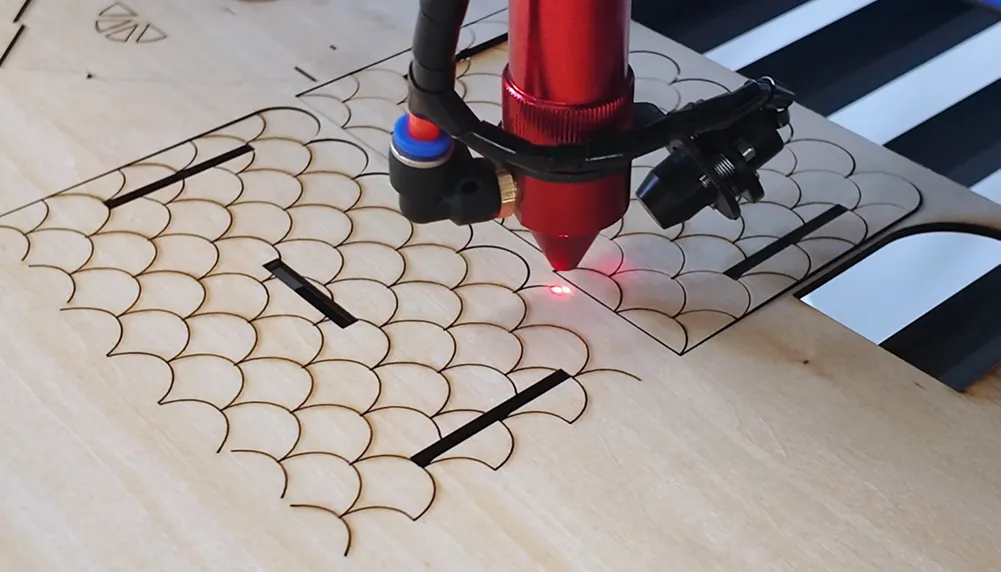
Second, laser thermal cutting causes permanent damage to various decorative substrates. High temperature laser melts PVC printing layers, leaves yellow burnt marks on oil canvas and deforms thin acrylic sheets. The surface printed patterns will fade and blur, completely destroying the decorative texture of finished paintings. Meanwhile, laser processing releases irritating toxic smoke, which cannot pass environmental inspections of domestic and overseas factories.
Third, single equipment can only process limited types of decorative materials. Laser machines are not suitable for soft woven canvas, while manual cutting tools cannot cut rigid acrylic boards smoothly. Factories have to purchase multiple sets of cutting equipment to produce canvas paintings, PVC prints and acrylic decorative pieces at the same time, increasing equipment investment and workshop space occupation cost.
Fourth, unreasonable manual layout leads to serious waste of high-cost decorative raw materials. Oil canvas, transparent acrylic and coated PVC belong to high-price art materials. Workers arrange blanks only by personal experience without intelligent nesting optimization, generating massive leftover scraps and continuously compressing product profit margins.
Fifth, lack of stable material fixation leads to stretching and shifting during cutting. Soft linen canvas and thin PVC film have strong ductility. Without full vacuum adsorption, materials will wrinkle and slide under cutting force, making cut picture cores unable to match standard frames and raising rework workload greatly.
Traditional Cutting VS Vibrating Knife Cutter: Core Competitive Advantages
- One-click fully automatic operation supports arbitrary size & arbitrary irregular shapesAfter importing artwork CAD files into the supporting control system, the machine completes all cutting procedures with one click, without manual tracing, repeated measurement or secondary trimming. Whether regular square, round decorative paintings or complex hollow, curved wall art outlines can be processed continuously and stably, greatly shortening single-piece processing time and lifting factory daily output several times.
- Multi-material universal design integrates soft cloth, plastic and rigid board processingAdjustable high-frequency vibration blade with variable amplitude adapts to all mainstream decorative materials in one single unit. Woven canvas, thin PVC print cores and solid acrylic sheets do not need separate cutting machines, reducing one-time equipment procurement cost and saving limited workshop area for small and medium art factories.
- Pure cold physical cutting retains intact original decorative textureThe whole cutting process generates zero heat, so there will be no melting, scorching, fading or thermal deformation on material surfaces. Oil canvas maintains soft woven texture without burnt thread ends; PVC printed patterns stay bright and clear without blurring; acrylic boards are cut into smooth transparent edges without sticky molten residues, fully meeting high-end decoration quality standards. No harmful smoke is produced during operation to build clean compliant workshop environment.
- Intelligent automatic nesting algorithm greatly reduces art material wasteBuilt-in professional layout software for decorative products automatically arranges multiple artwork outlines on whole rolls or whole sheets of raw materials, reasonably filling blank gaps to minimize leftover scraps. Material utilization rate rises 13%–22% compared with manual placement, cutting long-term high-cost art raw material expenditure for mass custom production.
- Full-surface vacuum adsorption platform eliminates material deformation and offsetWhole-table negative pressure vacuum tightly locks all soft and hard decorative materials during high-speed cutting. Linen canvas cannot stretch; thin PVC film will not slide; acrylic sheets stay fixed without displacement. Cutting accuracy reaches ±0.1mm, all cut picture cores fit standard frames perfectly and drastically lower defective product rate.
- Low labor dependence reduces long-term operating costsA single set of vibrating knife cutting equipment can replace 4–6 skilled manual cutting workers. Only one ordinary entry-level operator is required to load raw materials and collect finished art pieces, effectively solving the pain of labor shortage and high labor cost for decorative painting manufacturers.
Complete List of Applicable Decorative Cutting Materials
The dedicated decorative vibrating knife cutter adapts all mainstream raw materials for home and commercial custom wall art, covering woven textile, plastic print film and rigid transparent panel materials. The full material range includes pure linen oil canvas, polyester printing canvas, cotton decorative cloth, matte PVC print core, frosted PVC film, transparent acrylic sheet, matte acrylic panel, multi-layer fabric foam composite wall cloth, self-adhesive decorative film, microfiber printed art cloth and lightweight foam backing decorative blanks.
Physical Characteristics of Main Decorative Materials & Matching Cutting Performance
- Linen & polyester oil canvasPhysical features: Loose woven fiber structure, good ductility easy to stretch without fixation; heat-sensitive fiber ends melt and form hard burrs under thermal cutting, destroying soft canvas hand feel.Cutting matching: Low-amplitude gentle cold vibration separates woven fibers neatly; full vacuum adsorption prevents canvas stretching, cutting edges are smooth without loose threads and no edge sealing treatment is needed.
- PVC printed decorative sheet & frosted filmPhysical features: Thin plastic substrate with thin color ink coating on surface; ink layer fades and blurs under high temperature; thin film wrinkles and slides easily without vacuum fixation.Cutting matching: Stable low-pressure vibration cuts PVC without scratching printed patterns; vacuum table eliminates thin film offset, printed graphics remain complete and bright after cutting.
- Transparent & matte acrylic boardPhysical features: Rigid solid plastic panel; laser high temperature melts acrylic to form sticky molten edges that cannot be polished smooth; strong extrusion leaves permanent indentations on panel surface.Cutting matching: Balanced medium vibration force realizes cold separation without thermal melting; cut acrylic edges are transparent smooth without sticky residues, no secondary grinding required.
- Multi-layer fabric foam composite wall clothPhysical features: Woven decorative surface bonded with porous foam backing; inconsistent hardness between cloth and foam layers, easy delamination under unstable cutting force.Cutting matching: Controllable cutting depth locks composite layers tightly during vibration cutting, no separation or dislocation between fabric surface and foam liner.
In summary, CNC cold vibrating knife cutting machines solve all core production bottlenecks of traditional manual and laser cutting from automation degree, multi-material compatibility, finished product quality, raw material saving and labor cost dimensions. For manufacturers focusing on customized decorative paintings, framed art and commercial wall decor, this intelligent digital cutting equipment is an irreplaceable production upgrade solution to improve order delivery efficiency and profit margins.